My latest article is now on The Humanist (first published 08 May 2017). Below is an excerpt.
The best way to redress the inequities in science is through structural reform. This means reviewing policy through an evidence-based process. A more productive approach to diversity focuses on responsibilities of leaders to enhance measurable results. In other words, for science to make the most of everyone’s talents, leaders must “walk the talk,” modelling best practice and promoting accountability for themselves and other managers.
A vision for social change that eliminates existing inequalities must incorporate the leadership, professional expertise, and lived experiences of minorities from diverse backgrounds. Without decision-making power to shape the strategy and planning of any event, program, or organization, minorities remain on the margins. Subsequently, lacking the active representation of humanity, the full benefits of science and social justice endeavors will be limited in influence and impact.
This article was first published on DiverseScholar, on 27 March 2017.
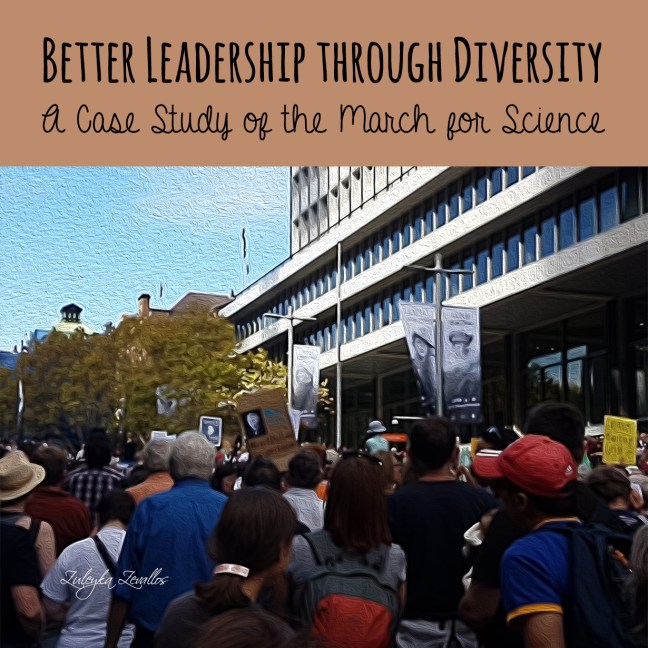
Following the high profile of the Women’s March against the Trump Administration on January 21, 2017, the idea for March for Science (MfS) grew from various social media conversations by scientists who wanted to rally against the science policy changes, funding cuts, gag orders, and the administrative overhaul of science organisations by the Trump Government [Zevallos 2017a]. The MfS has had an unusual trajectory for a social justice movement. Most organisations emerge through a collective of like-minded individuals who pass through four key phases of social action (forming, storming, norming, performing) that lead to the articulation of public goals and actions [Tuckman 1965]. The MfS has followed a rather haphazard path. A website and social media communities were first established, initially emerging as a Twitter account on January 24. MfS promoted the idea of a March using social media without having put together a formal team beyond its two founding co-chairs [Zevallos 2017a]. At the time of writing, these accounts have over 2 million supporters.[i]
The march is scheduled to occur globally on April 22 in over 400 cities. The aims and functions of the march have been drastically altered in the first two months of its existence, especially as the organisers began to receive critique from the scientific community. By early-March, the five “core goals” of the march were settled; one of which is: “Diversity and Inclusion in STEM” (science, technology, engineering, and mathematics).
In media interviews and through its social media communications, the organisers have undermined this goal. By early February, the organisers set up the march by making two problematic statements:
the march was not about scientists, but instead, “It’s about science” [Zamudio-Suaréz 2017].
Inadvertently these two premises have created an anti-diversity discourse that has been subsequently adopted by a vocal majority of the MfS supporter base.
Discourses are tricky…entrenched
In sociology, the concept of discourse describes how language comes to convey and justify dominant ways of thinking, talking, and behaving [Weedon 1996]. Discourses are built around the social identities, values, interests, and power of dominant groups [Foucault 1980]. This means that the stories we tell about “Why things are the way they are,” reinforce the status quo, and thus justify the reasoning, policies, and practices of groups that already have institutional control [Foucault 1965; 1994].
Discourses are tricky: they become firmly entrenched in our imagination as the “right” way of thinking because of the way we are raised, as well as how we are trained in specific professional fields. Discourses often mask value judgements that support the rights of some groups over others. This means that discourses reproduce inequality without us taking much notice.
The idea that White men are the taken-for-granted norm of what it means to be a scientist is learned early in school, and then reinforced throughout education, career progression, prestigious prizes, the publications, and funding systems [Zevallos, Samarasinghe, and Rao 2014]. Institutional mechanisms in science serve to reinforce a discourse that naturalises White men’s dominance in science [Zevallos 2017a].
Counter-discourses challenge the norm. They represent ways to resist and revolutionise existing power relations [Diamond and Quinby 1988]. So how do we establish a counter-discourse for science that embraces diversity as a strength?
I will show how the MfS organisers have come to reproduce the existing discourse of science, by normalising the interests of scientists who are White and from majority backgrounds. I present an analysis on public reactions to the third (of four) MfS diversity statements that reflect this position (see the statements in Appendix A). I will illustrate how taking a proactive, counter-discourse position on diversity will improve current relations with underrepresented scientists who have lost confidence in the march due to issues of inclusion [cf. Zevallos 2017f].
The purpose of this analysis is to encourage critical thinking about how the march organisers communicate with the public, and to strengthen awareness of how science discourses reinforce exclusion. Bear in mind that discourses are not always reflected consciously, and so the march organisers and commenters may not be aware of the historical and cultural impact of the ideas they express. Sociological methods make explicit the hidden meaning that individuals take-for-granted, placing ideas in broader social context.
I start by showing the organisers’ shifting diversity position.
Diversity has been an ongoing theme of my research, since I conducted my Honours and PhD theses and my subsequent research on migration, intercultural communication and how gender affects industrial practices. Lately I’ve been working on diversity issues in science and business. This includes how social science can be used to improve management of multicultural workplaces, and how gender diversity is important to the Internet. There is a lack of diversity in sociology that also needs attention. Our traditions still privilege the knowledge of White researchers from Europe and North America (more on this another time), but we also have a narrow academic vision of what it means to practice sociology. Similarly other sciences are structured around the skills and knowledge of White middle class men. Here’s an overview of my recent writing on these issues.



 Dr Zuleyka Zevallos - Sociology Prose