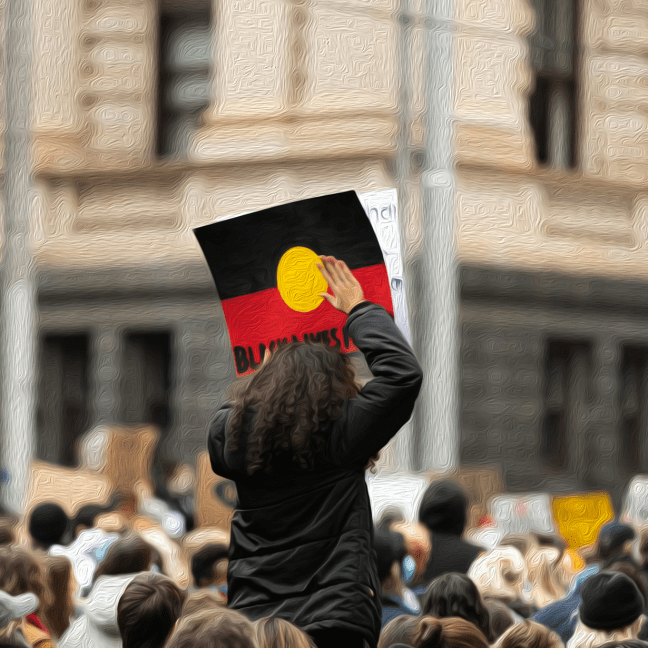
Indigenous Sociology for Social Impact

Published on The Sociological Review.

The history of Aboriginal and Torres Strait Islander social justice activism to destabilise and overcome colonial practices in Australia began with the British invasion in 1788 and has continued to the present-day. These acts of social and political organisation have strong sociological resonance that should centrally inform sociological inquiry in Australia. Yet Indigenous knowledges are peripheral to the discipline of sociology. This post is the first in a series exploring ways to decolonise sociology, through the leadership of Associate Professor Kathleen Butler, sociologist and Aboriginal woman belonging to the Bundjalung and Worimi peoples of coastal New South Wales.

Continue reading Indigenous Sociology for Social Impact

Racial and Gender Justice for Aboriginal Women in Prison

Published on Women’s Policy Action Tank, 18 July. Read an excerpt below.

Continue reading Racial and Gender Justice for Aboriginal Women in Prison

Study Confirms Intimate Partner Violence Leading Health Risk Factor for Women

Aboriginal woman medical doctor stares out of a large window

Kim Webster, University of Melbourne and Zuleyka Zevallos, Swinburne University of Technology

This article was originally published on The Conversation, 1 November 2016.

Barely a week passes without a media report of the suffering or tragic death of a woman at the hands of a partner. Typically, these accounts focus on the individuals involved. While important, in isolation, such a focus can belie the fact intimate partner violence is a wider social problem, obscuring both the factors contributing to it and opportunities to prevent it.

A study being launched today by Australia’s National Research Organisation for Women’s Safety confirms the serious impacts of intimate partner violence. The analysis, undertaken by the Australian Institute of Health and Welfare, provides estimates of the impact of intimate partner violence on women’s health.

Data from the Personal Safety Survey, Australia’s most reliable violence prevalence survey, was used as a key input.

Since the age of 15, one in four women in Australia have experienced at least one incident of violence by a partner. This includes violence perpetrated by a live-in partner as well as boyfriends, girlfriends or dates. This is based on a definition of violence, used by the Personal Safety Survey, which includes physical and sexual assault, as well as face-to-face threats the victim believed were likely and able to be carried out.

When emotional abuse by a live-in partner is included, (defined as controlling behaviours aimed at causing fear or emotional harm), it is estimated one in three women have experienced violence or abuse by an intimate partner. Continue reading Study Confirms Intimate Partner Violence Leading Health Risk Factor for Women

Sociology for Diversity

Diversity has been an ongoing theme of my research, since I conducted my Honours and PhD theses and my subsequent research on migration, intercultural communication and how gender affects industrial practices. Lately I’ve been working on diversity issues in science and business. This includes how social science can be used to improve management of multicultural workplaces, and how gender diversity is important to the Internet. There is a lack of diversity in sociology that also needs attention. Our traditions still privilege the knowledge of White researchers from Europe and North America (more on this another time), but we also have a narrow academic vision of what it means to practice sociology. Similarly other sciences are structured around the skills and knowledge of White middle class men. Here’s an overview of my recent writing on these issues.

Sociology for Diversity

Continue reading Sociology for Diversity