My latest article is now on The Humanist (first published 15 May 2017). Below is an excerpt.
In his latest podcast episode titled “Forbidden Knowledge,” atheist author Sam Harris guides political scientist Charles Murray through an extensive defence of Murray’s widely debunked body of work, focusing mostly on The Bell Curve. Co-authored with psychologist Richard Herrnstein (who died around the time it was published in 1994), the book was universally critiqued as an example of modern-day scientific racism.
The Bell Curve was founded on a flawed premise that inferred a correlation between intelligence, socio-economic achievement, and genetics, without accounting for the effects of discrimination. The research was funded by the eugenics-promoting Pioneer Fund, while academics like Stephen Jay Gould showed that The Bell Curve obscured data.
Time has proven the book to be scientifically “reckless.” It enjoys a resurgence in 2017, the era of Trump, specifically because it is read as proof that White people are superior to racial minorities, especially Black and Latin people. […]
Harris’s characterizations of Murray’s critics are a projection of the push back he feels he’s unfairly faced. “You were one of the canaries in the coal mines,” Harris tells Murray. Having previously dismissed Murray, Harris now feels an affinity due to facing rebuke for racism (while continuing to espouse similar views).
The atheist movement has changed. Once the almost-exclusive domain of White men, calls for equality have challenged conversations, as diverse groups of women and minorities seek a more inclusive vision for atheism. It is telling that aggrieved White men feel more comfortable hosting uncritical discussions on scientific racism than engaging in anti-racism practices to reform the movement.
My latest article is now on The Humanist (first published 08 May 2017). Below is an excerpt.
The best way to redress the inequities in science is through structural reform. This means reviewing policy through an evidence-based process. A more productive approach to diversity focuses on responsibilities of leaders to enhance measurable results. In other words, for science to make the most of everyone’s talents, leaders must “walk the talk,” modelling best practice and promoting accountability for themselves and other managers.
A vision for social change that eliminates existing inequalities must incorporate the leadership, professional expertise, and lived experiences of minorities from diverse backgrounds. Without decision-making power to shape the strategy and planning of any event, program, or organization, minorities remain on the margins. Subsequently, lacking the active representation of humanity, the full benefits of science and social justice endeavors will be limited in influence and impact.
My latest article is now on Women’s Policy Action Tank (first published 24 April 2017). Below is an excerpt.
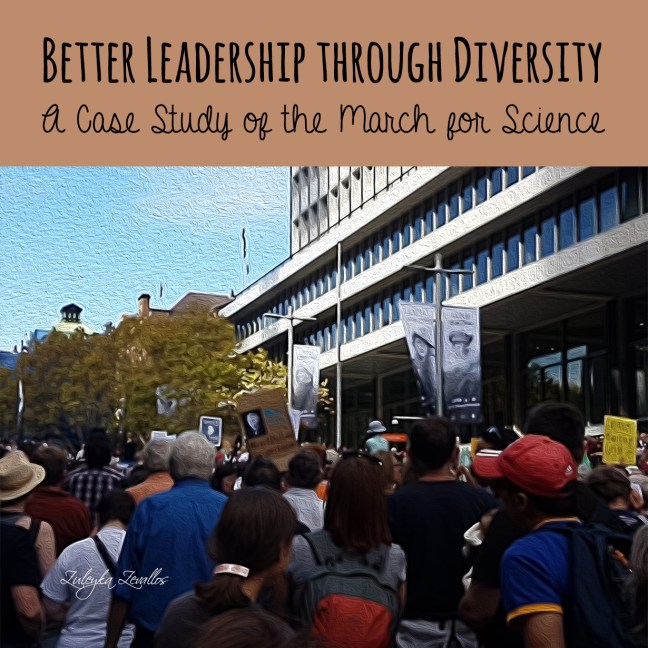
Over the weekend, thousands participated in the March for Science, both in Australia and globally. Influenced by the Women’s March, the March for Science has struggled with reflecting the highly diverse scientific community. In today’s post, sociologist Zuleyka Zevallosprovides a brief history of the controversies, explains why diversity in science is important, and provides practical suggestions for moving forward on stronger footing.
The issues for the global March for Science, as well as the national marches in Australia, are fundamental to issues of diversity in STEM around the world. The march is a microcosm of the battle to create a more inclusive culture in STEM that truly values and promotes diversity.
We start with the backwards logic. The march began without diversity in mind. The diversity statements by the global march came only after various mistakes and in response to critique from underrepresented scientists. Locally, there is no publicised diversity statement in the first instance, let alone a detailed strategy for equity, inclusion and access.
Extensive, longitudinal research shows that diversity statements and policies alone do not lead to greater diversity in the workplace. In fact, individual programs, whether it’s mentoring women or one-off training, do little to advance (only some) White women’s individual careers, and many programs have little effect on women of colour and other minorities. This is because programs are designed to “fix” individuals, without committing to changing the system.
Diversity is effective, and pays dividends in productivity, where equity, inclusion and accessibility are at the core of leadership and organisational practice. For an organisation to realise the full potential of diversity, leaders must not only model behavioural changes, but also lead proactive planning, evaluation and targeted solutions to transform their workplace culture. Superimposing a diversity statement on the existing structure allows only a few individuals to succeed while White men’s dominance remains unperturbed.
Diversity is just one of many important STEM issues in Australia, and one that should not take a backseat role to other pressing science issues. In fact, diversity undercuts all STEM policy matters. For example, Indigenous science is vital to addressing climate change and developing sustainable practices, as well as being indispensable to health initiatives, technology R&D, and other STEM ventures. Scientific potential will never be met unless Indigenous Australians lead STEM programs and activities, moving away from a deficit model to one of self-determination and empowerment in STEM. This includes activities like the March for Science. Imagine how an event that aspires to be a critical moment of change in STEM would have looked like with 60,000 years of ATSI wisdom leading its strategy!
This article was first published on DiverseScholar, on 27 March 2017.
Following the high profile of the Women’s March against the Trump Administration on January 21, 2017, the idea for March for Science (MfS) grew from various social media conversations by scientists who wanted to rally against the science policy changes, funding cuts, gag orders, and the administrative overhaul of science organisations by the Trump Government [Zevallos 2017a]. The MfS has had an unusual trajectory for a social justice movement. Most organisations emerge through a collective of like-minded individuals who pass through four key phases of social action (forming, storming, norming, performing) that lead to the articulation of public goals and actions [Tuckman 1965]. The MfS has followed a rather haphazard path. A website and social media communities were first established, initially emerging as a Twitter account on January 24. MfS promoted the idea of a March using social media without having put together a formal team beyond its two founding co-chairs [Zevallos 2017a]. At the time of writing, these accounts have over 2 million supporters.[i]
The march is scheduled to occur globally on April 22 in over 400 cities. The aims and functions of the march have been drastically altered in the first two months of its existence, especially as the organisers began to receive critique from the scientific community. By early-March, the five “core goals” of the march were settled; one of which is: “Diversity and Inclusion in STEM” (science, technology, engineering, and mathematics).
In media interviews and through its social media communications, the organisers have undermined this goal. By early February, the organisers set up the march by making two problematic statements:
the march was not about scientists, but instead, “It’s about science” [Zamudio-Suaréz 2017].
Inadvertently these two premises have created an anti-diversity discourse that has been subsequently adopted by a vocal majority of the MfS supporter base.
Discourses are tricky…entrenched
In sociology, the concept of discourse describes how language comes to convey and justify dominant ways of thinking, talking, and behaving [Weedon 1996]. Discourses are built around the social identities, values, interests, and power of dominant groups [Foucault 1980]. This means that the stories we tell about “Why things are the way they are,” reinforce the status quo, and thus justify the reasoning, policies, and practices of groups that already have institutional control [Foucault 1965; 1994].
Discourses are tricky: they become firmly entrenched in our imagination as the “right” way of thinking because of the way we are raised, as well as how we are trained in specific professional fields. Discourses often mask value judgements that support the rights of some groups over others. This means that discourses reproduce inequality without us taking much notice.
The idea that White men are the taken-for-granted norm of what it means to be a scientist is learned early in school, and then reinforced throughout education, career progression, prestigious prizes, the publications, and funding systems [Zevallos, Samarasinghe, and Rao 2014]. Institutional mechanisms in science serve to reinforce a discourse that naturalises White men’s dominance in science [Zevallos 2017a].
Counter-discourses challenge the norm. They represent ways to resist and revolutionise existing power relations [Diamond and Quinby 1988]. So how do we establish a counter-discourse for science that embraces diversity as a strength?
I will show how the MfS organisers have come to reproduce the existing discourse of science, by normalising the interests of scientists who are White and from majority backgrounds. I present an analysis on public reactions to the third (of four) MfS diversity statements that reflect this position (see the statements in Appendix A). I will illustrate how taking a proactive, counter-discourse position on diversity will improve current relations with underrepresented scientists who have lost confidence in the march due to issues of inclusion [cf. Zevallos 2017f].
The purpose of this analysis is to encourage critical thinking about how the march organisers communicate with the public, and to strengthen awareness of how science discourses reinforce exclusion. Bear in mind that discourses are not always reflected consciously, and so the march organisers and commenters may not be aware of the historical and cultural impact of the ideas they express. Sociological methods make explicit the hidden meaning that individuals take-for-granted, placing ideas in broader social context.
I start by showing the organisers’ shifting diversity position.
This article was first published on Latino Rebels on 14 March 2017.
Inspired by the impact of the Women’s March, March for Science (MfS) emerged from a series of social media conversations. The ScienceMarchDC Twitter account was set up on January 24, and a Facebook page three days later. Their follower base ballooned from a couple of hundred people to thousands. At the time of writing, the Twitter account has 337,000 followers, the public Facebook page has more than 393,000 likes, and the private Facebook community has over 840,000 members. There are currently 360 satellite marches being organized in various American states and in many cities around the world.
The MfS organizers go to great pains to separate science from politics, and science from scientists, as if practice and policies are independent from practitioners. For example co-chair and biology postdoctoral fellow Dr Jonathan Berman says: “Yes, this is a protest, but it’s not a political protest.” Another co-chair, science writer Dr Caroline Weinberg, recently told The Chronicle: “This isn’t about scientists. It’s about science.” These sentiments strangely echo other highly publicized opposition to the march, and are being replicated in some of the local marches. The idea that a protest can be “not political” and that science can be separated from scientists are both political ideas. These notions privilege the status quo in science, by centring the politics, identities and values of White scientists, especially White cisgender, able-bodied men, who are less affected by changes to the aforementioned social policies.
Even as the movement gained swift momentum, the leadership and mission were unclear in one key area: diversity.
Discussions over the march are important not just due to the planned demonstration. The debates matter because they reflect broader issues of diversity in science.
This article was first published in The Conversation, on January 29, 2016.
The culture in astronomy, and in science more broadly, needs a major reboot following revelations early this year of another case of harassment against women by a senior male academic.
This article was first published in DiverseScholar, on 20 April, 2015.
In my previous DiverseScholar article, I showed why the study behind The New York Times Op Ed (claiming the end of sexism) was methodologically flawed and ideologically biased [Zevallos 2014]. I showed that a focus on an individual choice narrative to explain why women are disadvantaged in STEM (Science, Technology, Engineering and Math) is fundamentally unsound when understood alongside the long-standing empirical evidence from the social sciences. Here, I will review several science controversies related to the editorial and institutional decisions within STEM. These patterns show that everyday interactions contribute to gender inequality, from the use of images, to dress, to the way distinguished women scientists are described in the media. I start with a selected timeline of events highlighting gender inequality in STEM.
This article was first published in April 2012 by the Taylor & Francis journal, Intercultural Education.
Abstract
International students represent a large economic and international relations investment for Australia. Australian universities are increasingly relying upon overseas students for their revenue, but these institutions are not adequately addressing the special learning, linguistic, cultural and religious needs of these students. Despite their Australian education, international students experience various difficulties in finding work in their field of study after they graduate. Poor English-language, communication and problem-solving skills are the biggest obstacles to securing ongoing and satisfying jobs. Employer biases regarding international students are equally a problem. This paper provides a demographic context of the international student population in Australia and it also addresses the gaps impeding their full social participation in Australian educational institutions. This paper argues that a stronger focus on the socialisation of international students is likely to increase their educational and career satisfaction. Educational providers would better serve international students by focusing on practical learning, career-planning and reinforcing the social and cultural skills valued by Australian employers.
Spanish Abstract:
Los estudiantes internacionales representan una gran inversión económica así como de relaciones internacionales para Australia. Las universidades Australianas dependen financieramente cada vez mas del ingreso de estudiantes de ultramar, sin embargo no responden adecuadamente a las necesidades culturales, lingüísticas y religiosas de estos estudiantes. No obstante su formación universitaria, los estudiantes internacionales encuentran barreras para la obtención de empleo en su campo profesional luego de su graduación en universidades australianas. Este artículo presenta el contexto demográfico general de la población estudiantil internacional en Australia e identifica las barreras para su integración social. El argumento central en el presente artículo es que una mayor atención a la organización social de estos estudiantes puede no solamente mejorar su satisfacción educacional sino también profesional. Las instituciones educativas Australianas podrían ofrecer mejores servicios a los estudiantes internacionales si avocaran recursos para el entrenamiento de habilidades prácticas que ayudaran a estos estudiantes a planear su carrera y mejorar sus capacidades sociales y culturales.
Benefits of intercultural education in Australia
Keywords: international students; intercultural learning; employment; Australian labour market; graduate career planning.




 Dr Zuleyka Zevallos - Sociology Prose