04 November 2014, I was interviewed by Rebecca Schuman, for Slate. The article, ‘Don’t Worry Your Pretty Little Heads. A New York Times Op-ed Trolls the Academic Science Community,’ covers a recent New York Times op-ed, which argues that ‘Academic Science Isn’t Sexist.’ Below is an excerpt.
I had always planned to use this website to collate my various writing and social media, to have them all in one place. I’ll now bring you a weekly update on my current writing as well as a look at past posts from my different blogs and communities. I’ll organise the articles based on themes. This week is focused on my sociological writing about women’s issues. First, an overview on what I’ve been writing lately.
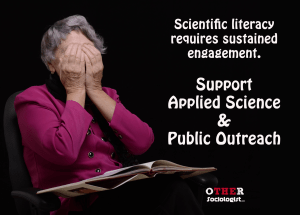
Scientific literacy requires sustained engagement. Support Applied Science & Public Outreach.
Over on my research blog, The Other Sociologist, I’ve written about How Media Hype Hurts Public Knowledge of Science. I discuss how scientists can better support public education by critiquing poor science reporting in the news. A recent example involved the media reporting that most people think that astrology is a science. This “factoid” came from a large study by the American National Science Foundation, but the results were quoted out of context and needed scientific critique. The broader study actually shows that the public do not really understand what scientists do, how our research is funded and the outputs of our work. This lack of knowledge undermines the public’s general understanding and trust in science. I argued that more scientists can get involved in diverse outreach activities to support public learning. This is part of a long-standing series I’ve been writing on how to improve public science education. Read more my blog.
A sociology degree provides critical thinking & persuasive interpersonal communication skills.
On Sociology at Work, I talked about How Sociology Class Discussions Benefit Your Career. I used this post to highlight how the group work we do during an undergraduate degree trains students for the types of activities they’ll carry out as applied researchers outside academia. This includes dealing with clients, running community consultations and thinking critically on our feet. Learn more.
The rest of this post is about my most recent writing on gender equality in business and in science and technology. Enjoy! Continue reading Sociology for Women
This study examines the ethnic identities of 50 second-generation migrant-Australian women aged 17–28 years. Twenty-five women were from Turkish backgrounds and 25 women were from South and Central American (or ‘Latin’) backgrounds. The overwhelming majority of the women interviewed for this study had travelled extensively to their families’ countries of origin, and their experiences growing up in Australia alongside their ongoing overseas visits shed light on transnational ties and the negotiation of ethnicity and belonging in the Australian multicultural context.
A typology of the women’s migrant-Australian identities highlights the differences and similarities of experiences among the women in both groups, and reveals the role of social context in shaping identity. Islam was a primary source of identification for most of the Turkish women, as a form of pan-ethnic identity. Participants exhibited a good deal of agency in their identity choices, and this was specifically connected to their transnational positioning. However, while most of the women took on a transnational identity to some degree, their experiences of racism and social exclusion reproduced an ambivalent sense of belonging to Australia. Their sense of being allowed to belong ‘where they are at’ remained salient to the ways in which they constructed their identities.
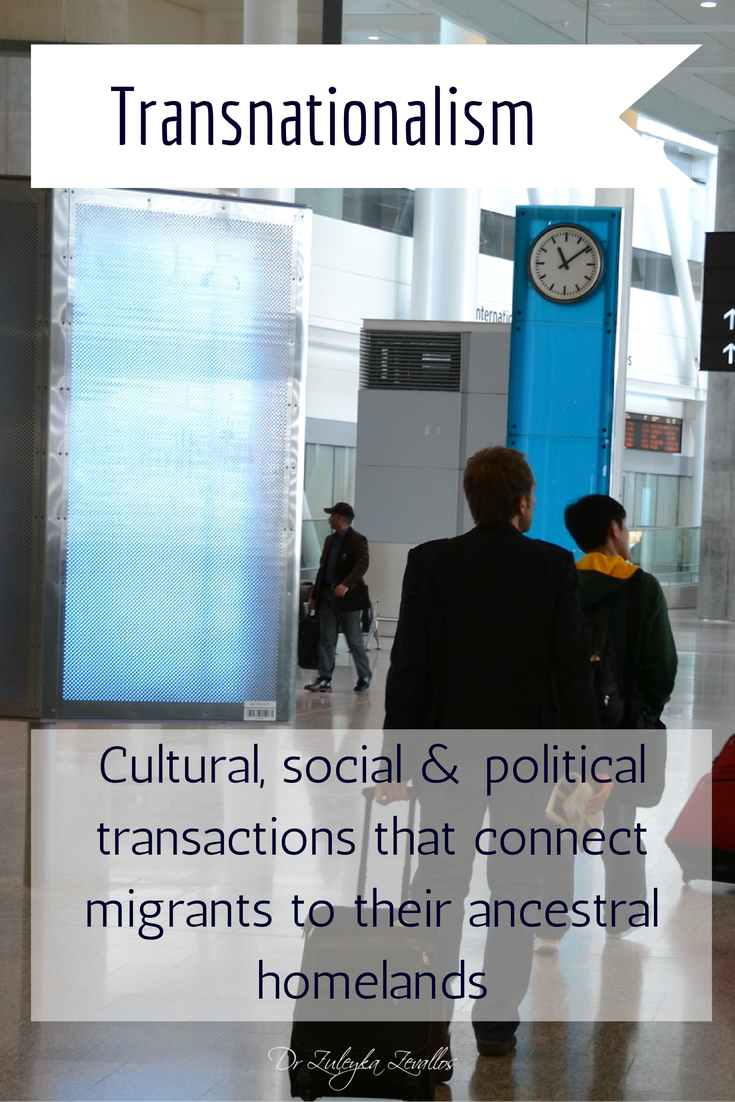
Transnationalism: Cultural, social & political transactions that connect migrants to their ancestral homelands. – Dr Zuleyka Zevallos
This paper explores issues of religion and identity among tertiary-educated Muslim women, and the role of education in negotiating social inclusion. Data was derived from 25 qualitative interviews with second-generation Turkish-Australian women aged 18 to 26 years. Sixteen women were attending Australian universities at the time of their interviews, and the other nine women had completed tertiary degrees. The paper examines the adoption of the hijab in the ‘presentation of self’ in the Australian context. The participants communicated an overwhelming support for the hijab as a rewarding religious practice that came with specific social duties given Australia’s status as a multicultural nation. The women likened the hijab to a ‘flag for Islam’, and so they advocated the view that Muslim women who wore the hijab literally embodied certain Islamic responsibilities, including the roles of spokesperson and educator on behalf of Islam. While they felt a sense of marginalisation from the Australian mainstream, these participants ultimately believed that the hijab provided them with an opportunity to bridge the communication gap between Muslims and non-Muslim Australians.
To this end, the women’s tertiary education shaped their understandings of the hijab in relation to Australia’s democratic ideals and its multiculturalism. This paper argues that education represents an important avenue for promoting inter-faith understanding and in strengthening young Muslim-Australians’ sense of inclusion within the multicultural nation.Continue reading The Hijab as a Social Tool for Identity Mobilisation, Community Education and Inclusion
This paper argues that Australian multiculturalism represents an ideology that migrants can draw upon in order to make sense of their everyday social experiences, their identities and their relationship to the nation. Ideology is a widely contested concept and it has various meanings. Generally, ideology refers to a normative set of beliefs that ‘tell us what we ought to do’ or how things should be, they are built upon central values and they have political value (Drucker 1974: 43). A narrative of national identity which is based on multiculturalism could be seen in terms of dominant and contested ideologies. For example, constructions of an Anglo-Celtic majority identity in Australian society could be seen as a dominant ideology, because such constructions maintain Anglo-Celtic hegemony despite our policies of multiculturalism (cf. de Lepervanche 1980; Hage 1998; Stratton 1998; Vasta 1996). Alternatively, constructions of the nation based on cultural pluralism could be seen as competing, or contested, ideologies because they challenge Anglo-Celtic dominance. Ideas are constructed by those in power as well as by less powerful people going about their everyday lives and so ideology can be challenged through social interaction and social discourses.
I am not looking at multicultural ideology in terms of dominant/competing ideologies, although I do discuss some hegemonic processes related to multiculturalism, such as the concept of race. I am more interested in looking at the ideology Australian multiculturalism as a set of normative beliefs that argue Australian society should be organised around a principle of cultural plurality, and what this entails, from the point of view of the women that I interviewed for my research (for definitions of multiculturalism as an ideology see Lopez 2000: 3; Vasta 1993: 212). I will also look at the benefits and costs that the ideology of multiculturalism has for my participants. Looking at multiculturalism as ideology allows us to ask, why do some people believe what they do about multiculturalism?, or as Betts put it, ‘what’s in it for them?’ (1999: 30). First, this paper describes the women’s constructions of Australian multiculturalism. Second it investigates issues of identity. Third, it discusses the impact of racist constructions of the Australian identity on the women’s sense of belonging to the nation. I conclude with a discussion of Australian multiculturalism as a lived ideology in relation to the data generated by my research.
This paper analyses data from 25 qualitative interviews to explore the relationship between religion, gender and sexuality for Turkish-Australian women aged 18-26. It argues that the hijab (headscarf) symbolises an idealised Muslim femininity be-cause it signifies to the participants a high level of personal religious commitment and it also embodies the Islamic mores of modesty and self-respect regarding their sexuality. Participants in the study explained that ‘a woman is precious like dia-monds, that’s why we have to keep her covered’. While they displayed a sense of agency in perceiving their ‘liberation’ from sexual objectification through the hijab, some ambiguity arose from their conceptualisation of an ideal Muslim femininity. This ambiguity is tied to Islamic and Australian narratives of female sexuality, which position women in a role responsible for regulating sexual expression and sexual attraction in both the private and public spheres. Continue reading “A Woman Is Precious”: Constructions of Islamic Sexuality and Femininity of Turkish-Australian Women
This article was first published in 2003 by the Journal of Sociology. Below is the final manuscript submitted for publication. The published version may have some minor editorial and formatting changes.
Abstract
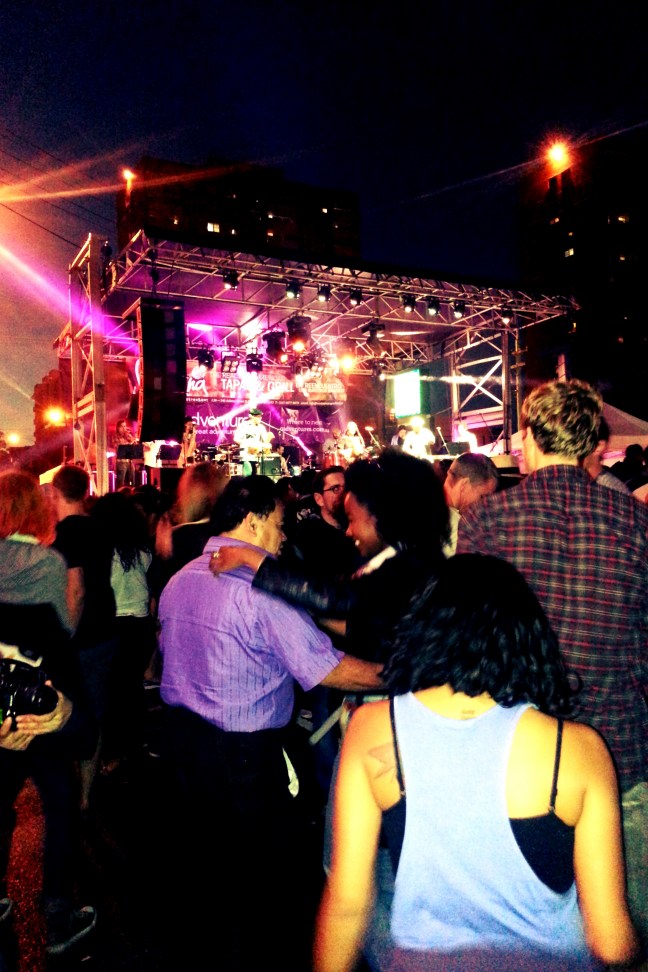
Through an analysis of qualitative interviews, this article explores the ethnic identities of Australian women aged 17–25 years of South and Central American backgrounds. The interviews show that expressions of Latin ethnicity are constructed around four ‘emblems’ symbolizing Latin ‘culture’– food, language, music and dancing, and festivity. Adopting a social constructionist perspective, this article details the respondents’ agency in the reconstruction of Latin ethnicity, and the consequences of the racial categorizations of ‘Australian-ness’ encountered by the participants. Their emphatic rejection of an Australian identity arises from their experiences growing up in Australia, where they are not ‘seen’ as Australian, highlighting that Australian identity continues to be regarded as synonymous with an Anglo-Celtic appearance. Nevertheless the respondents acknowledge Australian values of egalitarianism as significant when negotiating gender and sexuality. This ‘paradox’ of ethnic identity in the context of this study is best exemplified by the recurring comment, ‘That’s my Australian side’, and will be investigated through a critique on the limitations of ‘multicultural’ ideology and its lived experience.








 Dr Zuleyka Zevallos - Sociology Prose