This article was first published in DiverseScholar, on 20 April, 2015.
In my previous DiverseScholar article, I showed why the study behind The New York Times Op Ed (claiming the end of sexism) was methodologically flawed and ideologically biased [Zevallos 2014]. I showed that a focus on an individual choice narrative to explain why women are disadvantaged in STEM (Science, Technology, Engineering and Math) is fundamentally unsound when understood alongside the long-standing empirical evidence from the social sciences. Here, I will review several science controversies related to the editorial and institutional decisions within STEM. These patterns show that everyday interactions contribute to gender inequality, from the use of images, to dress, to the way distinguished women scientists are described in the media. I start with a selected timeline of events highlighting gender inequality in STEM.
On 11 November 2015, I was interviewed by Lauren Morello, for Nature. The article, ‘Science and sexism: In the eye of the Twitterstorm,’ explores how social media supports public discussion about sexism in science. Read an excerpt below.
Robust empirical research shows that women are less likely to be hired for STEM jobs, as well as promoted, remunerated and professionally recognised in every respect of academic life. Earlier this month, however, a widely reported study suggested gender bias is largely a myth. Zuleyka Zevallosevaluates the study and argues it fails to simulate the conditions in which hiring decisions are made. The process of hiring any professional is the outcome of social interaction. Biases shape social exchanges.
On 3 December 2014, I was interviewed by Stephanie Pappas, for Live Science. The article, ‘Wikipedia’s Gender Problem Gets a Closer Look,’ looks at sexism in Wikipedia. Wikimedia Foundation reports that only 10% of Wikipedia editors are women. Read an exercept below.
On 18 November 2014, I was interviewed by Simon Owens, for PBS MediaShift. The article, ‘Google Plus a Ghost Town? Not If You Look at Communities,’ explores the thriving communities on Google Plus. I discussed one of the communities I co-moderate with a team of a dozen scientists with PhDs in various fields, Science on Google+.
Over the past couple of months, I have been using sociology to show how everyday experiences of sexism and racism feed into the educational and career trajectories of women and minorities in various disciplines within Science, Technology, Engineering and Mathematics (STEM). Here I include summaries of my writing from recent times, which show how social policy can dramatically impact on women’s educational outcomes. I’ve also covered how childhood socialisation impacts on girls’ transition from school to university. Experiences in higher education are also gendered, that is, culture shapes how women and men think about what happens to them at university. We see this clearly in relationships with thesis supervisors and informal socialising, as well as in more formal processes in administration. I’ve also highlighted some progress in diversity, namely the appointment of a lesbian technology expert, Megan Smith, who now holds a key role with the American government. Despite this achievement, various controversies in STEM related to social media use by scientists, research on women and high profile science events signify that despite strides forward, women and minorities are still the targets of inequality and marginalisation.
04 November 2014, I was interviewed by Rebecca Schuman, for Slate. The article, ‘Don’t Worry Your Pretty Little Heads. A New York Times Op-ed Trolls the Academic Science Community,’ covers a recent New York Times op-ed, which argues that ‘Academic Science Isn’t Sexist.’ Below is an excerpt.
Diversity has been an ongoing theme of my research, since I conducted my Honours and PhD theses and my subsequent research on migration, intercultural communication and how gender affects industrial practices. Lately I’ve been working on diversity issues in science and business. This includes how social science can be used to improve management of multicultural workplaces, and how gender diversity is important to the Internet. There is a lack of diversity in sociology that also needs attention. Our traditions still privilege the knowledge of White researchers from Europe and North America (more on this another time), but we also have a narrow academic vision of what it means to practice sociology. Similarly other sciences are structured around the skills and knowledge of White middle class men. Here’s an overview of my recent writing on these issues.
I had always planned to use this website to collate my various writing and social media, to have them all in one place. I’ll now bring you a weekly update on my current writing as well as a look at past posts from my different blogs and communities. I’ll organise the articles based on themes. This week is focused on my sociological writing about women’s issues. First, an overview on what I’ve been writing lately.
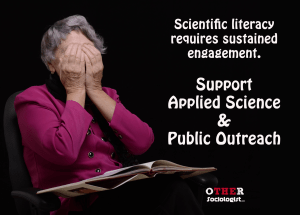
Scientific literacy requires sustained engagement. Support Applied Science & Public Outreach.
Over on my research blog, The Other Sociologist, I’ve written about How Media Hype Hurts Public Knowledge of Science. I discuss how scientists can better support public education by critiquing poor science reporting in the news. A recent example involved the media reporting that most people think that astrology is a science. This “factoid” came from a large study by the American National Science Foundation, but the results were quoted out of context and needed scientific critique. The broader study actually shows that the public do not really understand what scientists do, how our research is funded and the outputs of our work. This lack of knowledge undermines the public’s general understanding and trust in science. I argued that more scientists can get involved in diverse outreach activities to support public learning. This is part of a long-standing series I’ve been writing on how to improve public science education. Read more my blog.
A sociology degree provides critical thinking & persuasive interpersonal communication skills.
On Sociology at Work, I talked about How Sociology Class Discussions Benefit Your Career. I used this post to highlight how the group work we do during an undergraduate degree trains students for the types of activities they’ll carry out as applied researchers outside academia. This includes dealing with clients, running community consultations and thinking critically on our feet. Learn more.
The rest of this post is about my most recent writing on gender equality in business and in science and technology. Enjoy! Continue reading Sociology for Women
More public discussion on science alone is unlikely to convince people to productively engage in scientific discussions. Zuleyka Zevallos explores the sociology of beliefs, values and attitudes and calls for wider reflexive critical thinking on how scientists understand science and the public. The social sciences in particular are well-poised to improve the public’s trust in science as they are focused on the influence of social institutions on behaviour and can instigate a multidisciplinary dialogue about what it means to do science.






 Dr Zuleyka Zevallos - Sociology Prose