On 18 November 2014, I was interviewed by Simon Owens, for PBS MediaShift. The article, ‘Google Plus a Ghost Town? Not If You Look at Communities,’ explores the thriving communities on Google Plus. I discussed one of the communities I co-moderate with a team of a dozen scientists with PhDs in various fields, Science on Google+.
Over the past couple of months, I have been using sociology to show how everyday experiences of sexism and racism feed into the educational and career trajectories of women and minorities in various disciplines within Science, Technology, Engineering and Mathematics (STEM). Here I include summaries of my writing from recent times, which show how social policy can dramatically impact on women’s educational outcomes. I’ve also covered how childhood socialisation impacts on girls’ transition from school to university. Experiences in higher education are also gendered, that is, culture shapes how women and men think about what happens to them at university. We see this clearly in relationships with thesis supervisors and informal socialising, as well as in more formal processes in administration. I’ve also highlighted some progress in diversity, namely the appointment of a lesbian technology expert, Megan Smith, who now holds a key role with the American government. Despite this achievement, various controversies in STEM related to social media use by scientists, research on women and high profile science events signify that despite strides forward, women and minorities are still the targets of inequality and marginalisation.
04 November 2014, I was interviewed by Rebecca Schuman, for Slate. The article, ‘Don’t Worry Your Pretty Little Heads. A New York Times Op-ed Trolls the Academic Science Community,’ covers a recent New York Times op-ed, which argues that ‘Academic Science Isn’t Sexist.’ Below is an excerpt.
Diversity has been an ongoing theme of my research, since I conducted my Honours and PhD theses and my subsequent research on migration, intercultural communication and how gender affects industrial practices. Lately I’ve been working on diversity issues in science and business. This includes how social science can be used to improve management of multicultural workplaces, and how gender diversity is important to the Internet. There is a lack of diversity in sociology that also needs attention. Our traditions still privilege the knowledge of White researchers from Europe and North America (more on this another time), but we also have a narrow academic vision of what it means to practice sociology. Similarly other sciences are structured around the skills and knowledge of White middle class men. Here’s an overview of my recent writing on these issues.
I had always planned to use this website to collate my various writing and social media, to have them all in one place. I’ll now bring you a weekly update on my current writing as well as a look at past posts from my different blogs and communities. I’ll organise the articles based on themes. This week is focused on my sociological writing about women’s issues. First, an overview on what I’ve been writing lately.
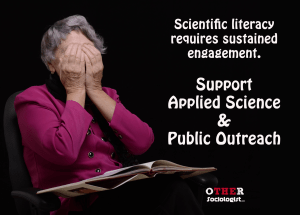
Scientific literacy requires sustained engagement. Support Applied Science & Public Outreach.
Over on my research blog, The Other Sociologist, I’ve written about How Media Hype Hurts Public Knowledge of Science. I discuss how scientists can better support public education by critiquing poor science reporting in the news. A recent example involved the media reporting that most people think that astrology is a science. This “factoid” came from a large study by the American National Science Foundation, but the results were quoted out of context and needed scientific critique. The broader study actually shows that the public do not really understand what scientists do, how our research is funded and the outputs of our work. This lack of knowledge undermines the public’s general understanding and trust in science. I argued that more scientists can get involved in diverse outreach activities to support public learning. This is part of a long-standing series I’ve been writing on how to improve public science education. Read more my blog.
A sociology degree provides critical thinking & persuasive interpersonal communication skills.
On Sociology at Work, I talked about How Sociology Class Discussions Benefit Your Career. I used this post to highlight how the group work we do during an undergraduate degree trains students for the types of activities they’ll carry out as applied researchers outside academia. This includes dealing with clients, running community consultations and thinking critically on our feet. Learn more.
The rest of this post is about my most recent writing on gender equality in business and in science and technology. Enjoy! Continue reading Sociology for Women
More public discussion on science alone is unlikely to convince people to productively engage in scientific discussions. Zuleyka Zevallos explores the sociology of beliefs, values and attitudes and calls for wider reflexive critical thinking on how scientists understand science and the public. The social sciences in particular are well-poised to improve the public’s trust in science as they are focused on the influence of social institutions on behaviour and can instigate a multidisciplinary dialogue about what it means to do science.
This article was first published in April 2012 by the Taylor & Francis journal, Intercultural Education.
Abstract
International students represent a large economic and international relations investment for Australia. Australian universities are increasingly relying upon overseas students for their revenue, but these institutions are not adequately addressing the special learning, linguistic, cultural and religious needs of these students. Despite their Australian education, international students experience various difficulties in finding work in their field of study after they graduate. Poor English-language, communication and problem-solving skills are the biggest obstacles to securing ongoing and satisfying jobs. Employer biases regarding international students are equally a problem. This paper provides a demographic context of the international student population in Australia and it also addresses the gaps impeding their full social participation in Australian educational institutions. This paper argues that a stronger focus on the socialisation of international students is likely to increase their educational and career satisfaction. Educational providers would better serve international students by focusing on practical learning, career-planning and reinforcing the social and cultural skills valued by Australian employers.
Spanish Abstract:
Los estudiantes internacionales representan una gran inversión económica así como de relaciones internacionales para Australia. Las universidades Australianas dependen financieramente cada vez mas del ingreso de estudiantes de ultramar, sin embargo no responden adecuadamente a las necesidades culturales, lingüísticas y religiosas de estos estudiantes. No obstante su formación universitaria, los estudiantes internacionales encuentran barreras para la obtención de empleo en su campo profesional luego de su graduación en universidades australianas. Este artículo presenta el contexto demográfico general de la población estudiantil internacional en Australia e identifica las barreras para su integración social. El argumento central en el presente artículo es que una mayor atención a la organización social de estos estudiantes puede no solamente mejorar su satisfacción educacional sino también profesional. Las instituciones educativas Australianas podrían ofrecer mejores servicios a los estudiantes internacionales si avocaran recursos para el entrenamiento de habilidades prácticas que ayudaran a estos estudiantes a planear su carrera y mejorar sus capacidades sociales y culturales.
Benefits of intercultural education in Australia
Keywords: international students; intercultural learning; employment; Australian labour market; graduate career planning.
A new sociological study finds that students who study online perceive that they have learned less in comparison to students who attend face-to-face lectures. The researchers, Kelly Bergstrand and Scott Savage, find that online students also feel they have been treated with less respect by their lecturers and they generally rate their courses more negatively. Is there an issue with the way sociology is taught specifically that does not translate well to an online environment, or is there something broader at play? Today’s post examines the skills and resources that sociology demands of students, and questions whether the training and delivery of these skills are being adequately supported by the higher education system. I also discuss the influence of larger online courses that are offered “free” to the public and how this relates to funding cuts and a push for online learning in the tertiary sector.
There has been an increase in consumers’ reliance on credit and rising consumer debt. The increase is especially problematic for those least able to afford debt of any kind – welfare recipients. This qualitative study reports on 120 Australian welfare recipients’ attitudes towards debt, their understanding about what constitutes acceptable debt and the debt-management strategies they adopt. The results of this research show that welfare recipients see debt as a way of life and as a means of survival in a society where a core value appears (to them) to be the acquisition of material wealth. Their status as income earners and therefore their capacity to service debt is less than others. Consequently, we could expect that their debt levels would be proportionally less; however, many participants in this research did not appear to understand the long term consequences of their level of debt. The paper concludes with a discussion as to how social marketing can be applied to potentially assist this vulnerable consumer group and the wider community.
Keywords: Vulnerable consumers; Consumer credit; Debt management; Social marketing
Co-authored by Lauren Tolsma and Zuleyka Zevallos This report was first published in 2009 by the Swinburne Institute for Social Research. I republish the summary and one of the findings chapter. The study can be read free and in its entirety via the link below.
Summary
This report provides a sociological analysis of the settlement and support services available to Muslim migrants living in the suburbs of Greater Adelaide, in the state of South Australia. In particular, we seek to learn how existing Muslim organisations address the collective needs of Muslim migrants in Adelaide. We present a critical analysis of the literature on community development with specific focus on the provision of services that aid economic development.
Broadly, we use the term ‘community development’ to refer to the process of organising, educating and encouraging the participation and collaboration of local residents and stakeholders in order to improve their collective outcomes and objectives. Stakeholders might include practitioners who work in the social welfare sector, community leaders, businesses and government agencies who work with Muslim communities. These stakeholders are able to provide funds, or exchange their skills, services, prestige or other forms of support in order to achieve social change. As a pilot case study of community development, we incorporate previously unpublished data on South Australian Muslim community organisations. This includes interviews with service providers, representatives and religious leaders, as well as field notes during visits to organisations and the public events that these groups hosted around Adelaide in 2008.
Our report considers different forms of social capital in relation to Muslim community development and service provision. Social capital refers to the norms, knowledge and status enacted by social actors through their participation in social networks in order to become more socially mobile, particularly by tapping into the resources and capacities of other groups who are better off. This concept is used to examine the power dynamics in negotiations of social and economic exchange among different Muslim organisations and other groups, including mainstream service providers and government officials.
Our study finds that many newly arrived Muslim migrants do not understand the breadth of government-sponsored services available to them, and so they largely rely on a couple of the smaller and widely trusted Muslim community organisations for all of their needs, rather than approaching mainstream organisations for specialised services. In this connection, because some Muslim organisations have stronger visibility among new arrivals, some groups are struggling to manage their members’ requirements, especially given their limited resources. Consequently, a small number of over-worked volunteers deliver targeted assistance for which they have no formal training or qualifications. This includes crisis counselling, occupational assistance and educational advice.
We suggest that an asset-based community development (ABCD) approach would strengthen the social network ties and resources both within and external to the Muslim organisations studied. The ABCD framework is an evaluation methodology which first identifies the social and material capacities that presently exist within particular organisations. This information is used to establish practical ways in which those resources might be used to enhance their service delivery. In order to mobilise the existing assets of Muslim organisations around South Australia, the report proposes the establishment of a South Australian Muslim Community Corporation (SAMCC) which would consist of Muslim community service providers, volunteers and their Muslim clients from around South Australia. We propose a number of recommendations regarding the SAMCC including:
Assisting equitable decision making among Muslim organisations via the SAMCC.
Rather than solely privileging religious leaders, the SAMCC is set up to encourage the inclusion of a broader range of Muslim ‘voices’ that would contribute to community development activities;
Recruiting a SAMCC media liaison to help disseminate important information via a multi-lingual, regularly updated Muslim community newsletter and website. This includes promoting non-Muslim participation in community events, focusing on secular activities, and making available a list of culturally sensitive, mainstream service providers to Muslim community groups;
Restructuring the existing grants scheme of community funding. This is with a view to supporting the long-term self-sustainability of a wider range of ‘grassroots’ Muslim community organisations;
Funding training and hiring professional staff. This would ease the burden of Muslim organisations that are widely used and trusted but currently overextended, while still allowing them to continue providing specialised services for Muslim migrants.
The idea of the SAMCC is to provide sustainability for the Muslim community groups currently in operation, by pooling together and taking better advantage of their existing resources. In this way, it complements the asset-based approach to community development, by mobilising existing social networks and the value that those networks have for ordinary Muslims living in South Australia.
The next section presents our findings from Chapter 5 of our report.
Co-authored: Z. Zevallos and N. Kontoleon This article was first published in 2008 as part of the refereed proceedings of The Australian Sociological Association Conference.
Abstract
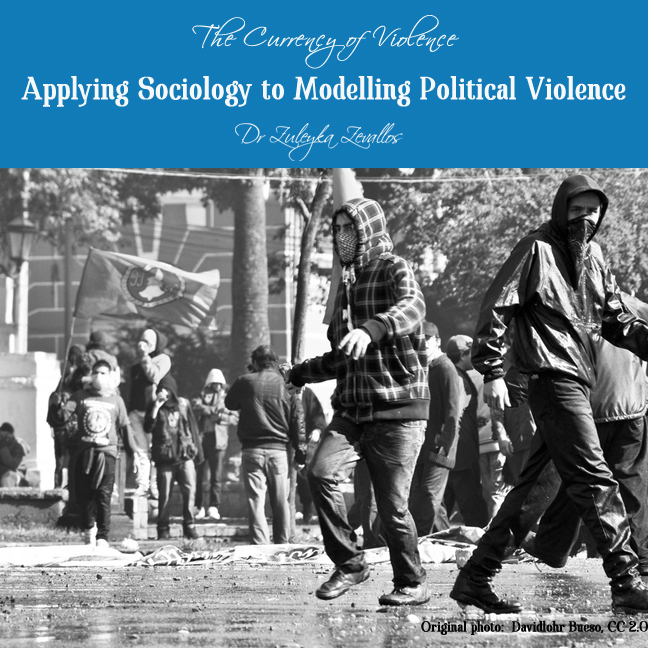
This paper explores the process of how sociological knowledge can be usefully applied in the development of a mathematical model of social phenomena. Specifically, it explores issues of translating sociological theory for the purposes of modelling and establishing the conceptual links necessary to achieve interdisciplinary understanding of political violence. The paper begins by describing the literature on violence in the Southern Philippines, focusing on Eric Gutierrez’s (2000) typology of violence. Second, it discusses social modelling as an interdisciplinary practice, including our reinterpretation of Gutierrez’ work into a conceptual scheme and how sociological theory might contribute to the development of a mathematical model based on this scheme. The paper concludes by discussing sociology’s contribution to interdisciplinary social modelling.
The discussion of interdisciplinary collaboration exemplifies how applied sociological knowledge can be appropriated for different audiences and in a variety of working contexts. This paper argues that social models which integrate sociological theories and concepts present an opportunity for people who are not social scientists to better understand the structural processes that might influence political violence.
Keywords: sociology as a discipline, crime and governance, economic, science and technology, power and inequality.










 Dr Zuleyka Zevallos - Sociology Prose